


Perfume Knowledge – Concentration, Longevity, Sillage
Three terms that are discussed more than understood in perfumery. Here is the factual clarification – without marketing exaggeration, without fanboy myths.
Concentration
Concentration describes the percentage share of pure fragrance oils in the perfume. The usual classes:
- Eau de Cologne: 2–5% fragrance oil · longevity 1–3 hours
- Eau de Toilette (EDT): 5–10% · 2–4 hours
- Eau de Parfum (EDP): 15–20% · 5–8 hours
- Extrait de Parfum (XDP): 25–40% · 10–16+ hours
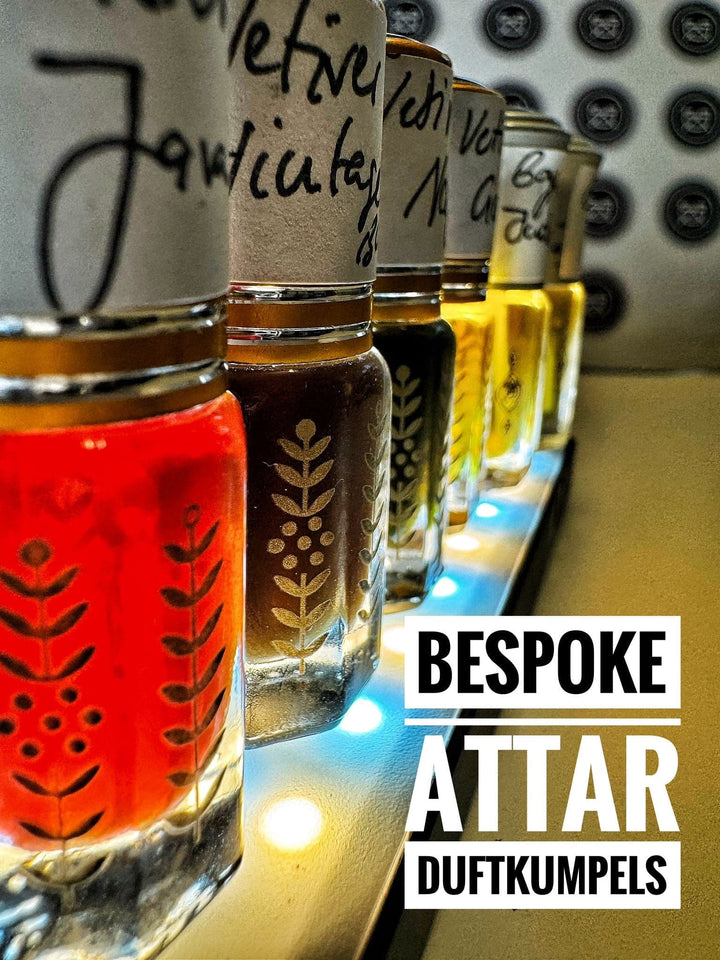
- Attar (alcohol-free): 40–100% · 18–48 hours
Higher concentration does not automatically mean "better". It means: more oil, less alcohol, slower evaporation, more complex layering. The extrait page covers XDP in detail.
Longevity
Longevity is the duration a perfume remains perceptible. Three measurements must be distinguished:
- Publicly perceptible: Others smell you in the room.
- Skin-close: You still smell the scent with your head tilted.
- On clothing: Residue on fabric without the influence of skin warmth.
An extrait de parfum with oud or musk as a base realistically reaches 10–16 hours on the skin, 2–3 days on clothing. Factors such as skin moisture, temperature, hormone balance and application site shift these values by ±30%.
Sillage
Sillage (French for "wake") describes the scent trail a perfume leaves in its surroundings. While longevity measures how long the scent is present, sillage measures how far it projects.
- Minimal (0–50 cm): Perceptible only close to the skin. Typical for pure oils, attars.
- Moderate (50 cm–1 m): Others smell you when hugging. Classic for EDP.
- Intense (1–3 m): Noticeable in small rooms. Extrait with oud or ambergris.
- Sillage monster (3 m+): Room-filling. Usually young oud oils or worn over-sprayed.
Niche perfumes with real raw materials often project moderately to intensely – without becoming intrusive. The "aura feeling" of real raw materials is inviting, not invasive.
What really matters with niche
- Declared raw materials: Are oud, ambergris, musk, castoreum literally stated on the label or product page? Or only vague "woody notes"?
- Batch number: Traceable?
- Maceration: Was the perfume left to mature (4–12 weeks)?
- Price-to-material ratio: Below 100 € per 30 ml extrait, real oud is unlikely.


